
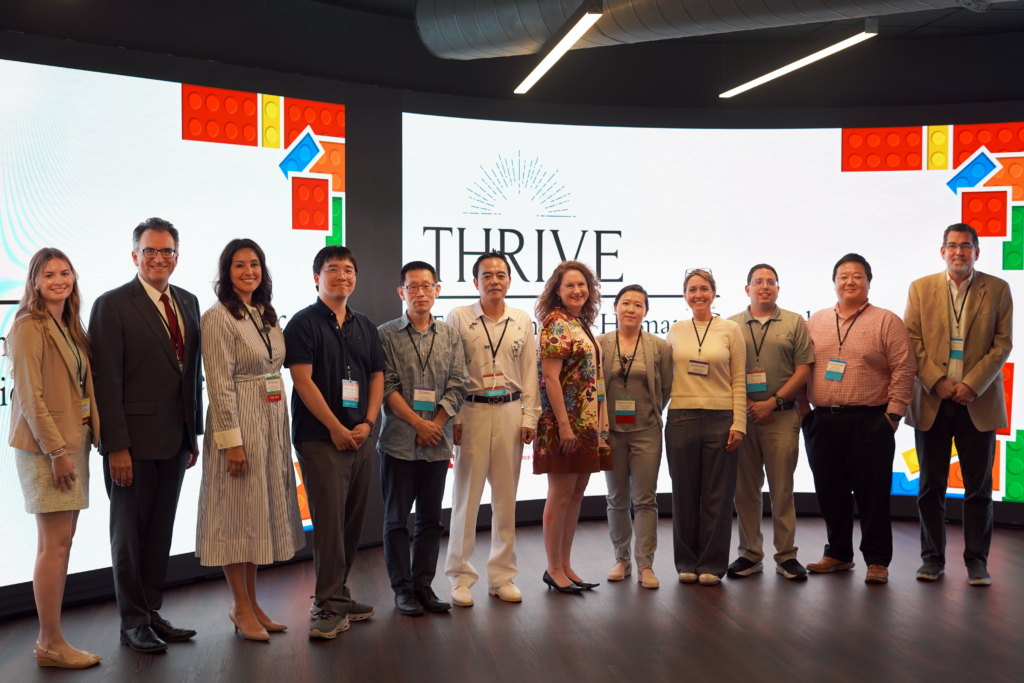
In the Institute for Social Science Research (ISSR), one program is redefining how faculty across campus approach research. By encouraging The University of Alabama’s top researchers to work together towards better solutions, the Transformative Human-centered Research for Impacting Vulnerabilities Everywhere (THRIVE) program encourages the interdisciplinary innovation that inspires meaningful impact.
“Most of us in this room might not expect a clothing designer and a researcher in mathematical optimization to find themselves working toward a common goal,” Interim Dean Dr. Lisa Pawloski said. “Yet, in the previous THRIVE cohort, those kinds of unexpected connections emerged. And isn’t it often at the intersection of different perspectives and areas of expertise where the most innovative ideas begin to take shape?”
The first THRIVE cohort consisted of nine THRIVE Fellows from five colleges and focused on increasing multi-PI National Institutes of Health (NIH) and Department of Defense (DoD) grant proposal submissions. Four Barefield College of Arts & Sciences faculty members, representing three departments, contributed to five of the nine proposal teams.
Dr. Susan Dewey, a THRIVE Fellow and a professor in the Department of Criminology & Criminal Justice, worked with a total of five collaborators on three proposal teams. Her work centers on violence, gender inequality and systems-involved populations, including two decades of experience conducting research in prisons, jails, shelters, and communities, but even she discovered something new as a THRIVE Fellow.
“This will definitely be one of my career highlights,” Dewey said. “For people at any career stage, this is an opportunity not to be missed.”
For one of her proposals, “Cloth-Based Colorimetric Contraband Drug Formaldehyde Sensors to Reduce Prison Violence,” Dewey worked with Dr. Ellen McKinney, a professor of clothing design, textiles and interior design; Dr. Dawen Li, a professor of electrical and computer engineering; and Dr. Steven Weinman, an associate professor of chemical and biological engineering. Headed by four researchers who are willing to engage across fields and explore shared questions, the project becomes one of the many ambitious, solutions-oriented grant proposals whose interdisciplinary expertise is one of one.
“In engineering, we often say, ‘Here’s a problem. Here’s a solution,’” Weinman said. “Susan [Dewey] starts by asking communities what they actually need. That really changed how I think about my work.”
While the main goal of THRIVE is to foster interdisciplinary collaboration, the program also prioritizes team science skills, communication across disciplines, professional growth, proposal development and leadership abilities. The second cohort of THRIVE Fellows, THRIVE 2.0, launched in August 2026 and continues to prioritize impact, integration and outcomes. With the goal of submitting an NIH or DoD proposal in 2027, THRIVE Fellows will work in research focus areas including critical and emerging technologies; national security, safety and community resilience; and health and human flourishing.
“THRIVE has become an important investment in the future of research at both the Barefield College of Arts & Sciences and The University of Alabama,” Pawloski said. “By providing the structure and support needed to transform innovative ideas into competitive, externally funded research, THRIVE is helping foster a culture of interdisciplinary research and discovery across our campus.”